


Tuberculosis (TB) transmission has traditionally been viewed as a relatively passive process: an infected person coughs, speaks or breathes, releasing Mycobacterium tuberculosis (Mtb) into the air, where the bacteria-containing droplets dry into tiny particles that can remain airborne and be inhaled by another person.
New research suggests that this period between hosts may be much more important than previously appreciated. The study, published in Nature Microbiology, shows that the stress of airborne transmission can not only challenge Mtb survival, but may also promote the emergence of mutations associated with antibiotic resistance (Figure 1).
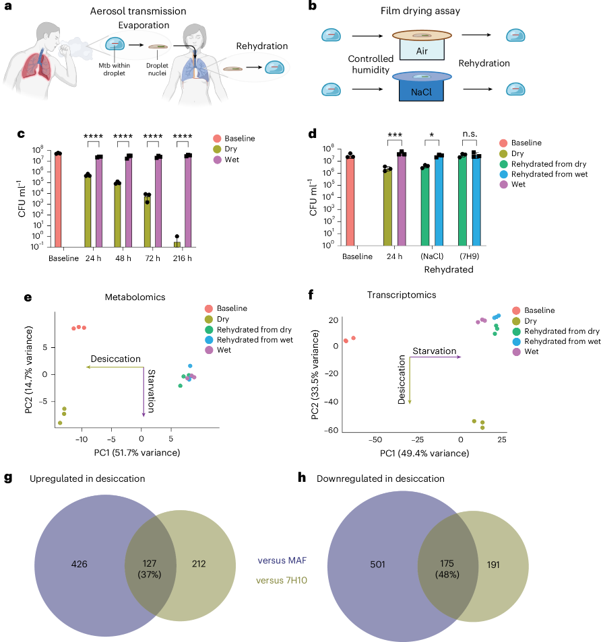
Figure 1: Modelling the desiccation component of aerosol transmission in Mtb. a, An infected host expels Mtb-laden droplets, which evaporate to form droplet nuclei; subsequently, these particles are inhaled by a susceptible individual. b, Schematic of drying assay to mimic a desiccation–rehydration cycle. Cells deposited on a sterile filter are allowed to dry out in temperature- and humidity-controlled air and are compared with the control condition left in contact with a 200 mM NaCl reservoir. c, CFU recovery over 1 week of drying compared with wet (saline) controls. Each bar contains three biological replicates and depicts one of two independent experiments. d, Recovery following 24 h of desiccation then 24 h rehydration into NaCl or 7H9 media before plating for CFU. Each bar contains three biological replicates and depicts one of two independent experiments. e, PCA plot of three biological replicates from one of two independent experiments comparing baseline (red) metabolome with 24 h of desiccation (gold), saline control (purple) and 24 h of rehydration into 200 mM sodium chloride after 24 h of desiccation (green) or saline incubation (blue). f, PCA plot of three biological replicates from one of two independent transcriptomics experiments with batch correction comparing baseline (red) transcriptome with 24 h of desiccation (gold), saline control (purple) and 24 h of rehydration into 200 mM sodium chloride after 24 h of desiccation (green) or saline incubation (blue). g,h, Comparisons of transcriptional changes on drying using cells adapted to either MAF-adapted or filter-mounted 7H10-adapted cells (7H10-adapted). Gene expression profiles were constructed for differential-expression analysis using DESeq2, which follows a negative binomial distribution and gene-specific dispersion parameters to calculate significance on the basis of an adjusted P value <0.05 using the Benjamini–Hochberg multiple hypothesis correction. Venn diagrams prepared using DeepVenn68 of genes with FC expression >2 (g) or FC <−2 (h) in 24 h dry versus MAF-adapted (blue) or 24 h dry versus 7H10-adapted (gold) Mtb. MAF: Model aerosol fluid18. Statistical significance calculated by two-way analysis of variance (ANOVA) with Tukey’s multiple hypothesis correction, P < 0.05 (*), 0.01 (**), 0.001 (***) or 0.0001 (****). Data are presented as mean values ± s.d. n.s., not significant. Schematics in a and b created in BioRender; Brown, C. https://biorender.com/tg2xnp3 (2026).
To investigate how Mtb survives outside the host, researchers recreated the drying and rehydration conditions experienced during aerosol transmission. They found that desiccation causes oxidative stress and DNA damage in the bacteria. In response, Mtb activates a DNA repair programme that helps it withstand the damaging conditions and recover once moisture becomes available again.
However, repairing damaged DNA comes with another consequence: mutations can arise during the process. The researchers found that desiccation increased the appearance of mutations associated with resistance to rifampin, one of the cornerstone antibiotics used to treat TB.
This suggests that airborne transmission may not simply move bacteria from one person to another, it may create an environment that contributes to bacterial evolution.
The study identified the DNA repair protein Mfd as an important component of this response.
When researchers reduced Mfd activity during aerosolization experiments, rifampin-resistant Mtb showed reduced survival. Analysis of more than 50,000 Mtb genomes from patients around the world provided additional support: strains carrying mutations in Mfd were less likely to contain a common rifampin-resistance mutation.
Together, these findings suggest that Mfd may help certain drug-resistant Mtb populations survive the stresses associated with transmission. TB already affects millions of people globally, with drug-resistant TB presenting a major challenge because treatment becomes longer, more complex and often more toxic.
The findings introduce an important new concept: the transmission stage itself may contribute to the evolution and persistence of drug-resistant TB.
Rather than considering transmission simply as the movement of bacteria between hosts, researchers may need to consider what happens to Mtb while it is exposed to environmental stresses outside the body.
Understanding these mechanisms could eventually lead to new strategies that complement existing TB treatments by targeting bacterial survival during transmission and potentially limiting the spread of resistant strains.
Mtb’s ability to survive the journey between hosts may be helping shape its evolution. Targeting these survival mechanisms could provide a new way to tackle both TB transmission and antimicrobial resistance.
Journal article: Brown, C.D., et al. 2026. Desiccation promotes DNA damage and rifampin resistance in Mycobacterium tuberculosis. Nature Microbiology.
Summary by Stefan Botha