


Researchers have discovered that the extracellular matrix (ECM) of the gut can retain lasting changes after severe inflammation, potentially helping drive chronic intestinal disease even after the initial injury has resolved (Figure 1).
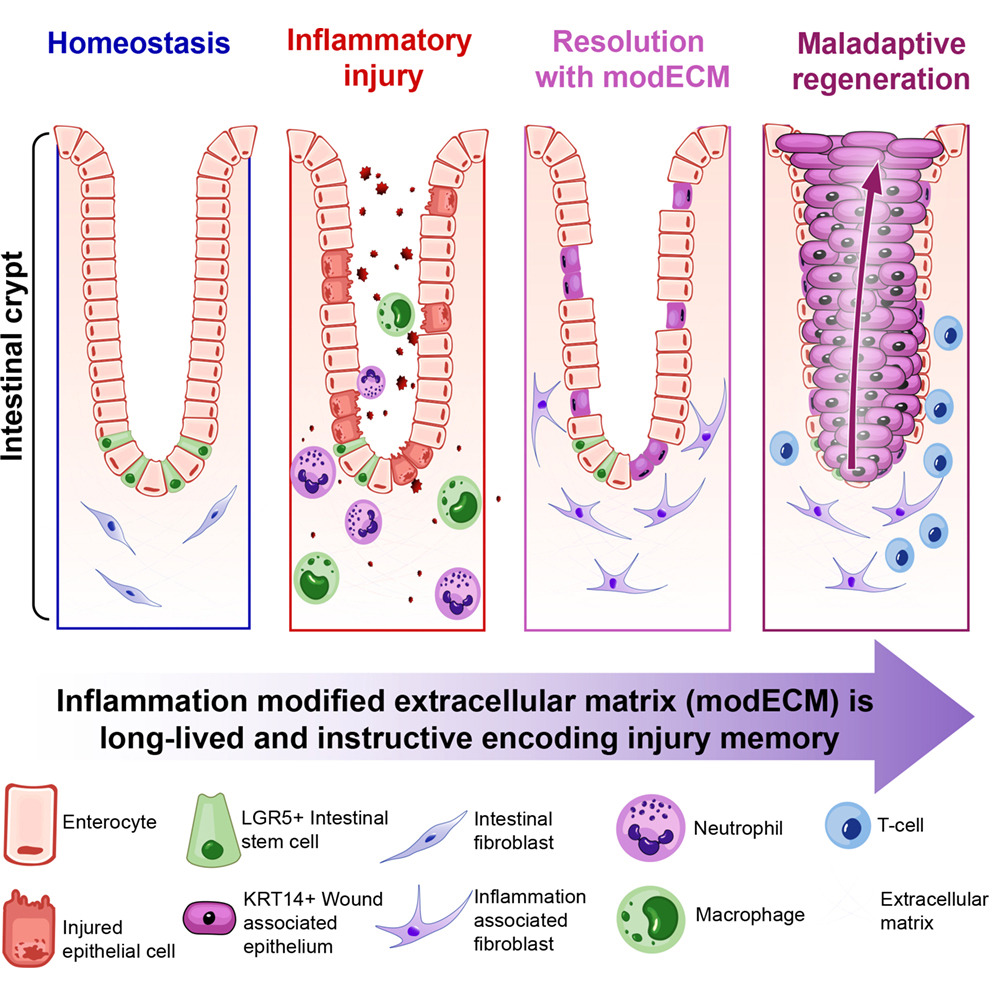
Figure 1: Graphical abstract.
The study focused on how the colon repairs itself following inflammation. While tissue regeneration is generally thought to restore the gut to its original state, researchers found that the ECM can instead undergo a persistent pathological transformation, which they termed modified ECM (modECM).
Using temporal multi-omics, biomechanical analyses and spatial fate mapping in models of colitis, the team found that inflammation caused long-lasting accumulation of collagen XVIII (COL18A1) alongside immune-driven breakdown of ECM components.
The altered ECM did more than provide structural support, it actively influenced how intestinal stem cells (ISCs) regenerated the damaged tissue.
Persistent modECM redirected Lgr5+ intestinal stem cells away from normal homeostatic epithelial regeneration and toward a wound-associated epithelial state characterised by pro-inflammatory gene activity.
Experiments outside the body showed that modECM alone was sufficient to alter ISC behaviour. It suppressed Wnt signalling, an important pathway for maintaining intestinal stem cells, while activating pathways associated with immune-cell recruitment.
In living animals, areas rich in modECM continued to attract T cells and promoted the emergence of KRT14+ epithelial cells from Lgr5+ progenitors. Rather than resolving completely after the initial injury, these regions therefore created a local environment that encouraged continued epithelial inflammation and immune activation.
Importantly, the researchers found evidence that a similar programme occurs in humans. Rectal biopsies from people with inflamed ulcerative colitis showed molecular signatures associated with both modECM and wound-associated epithelial cells.
These findings suggest that the ECM is not simply a passive scaffold that supports tissue repair. Instead, it can act as a long-lived biological record of previous inflammation, retaining molecular and structural changes that influence how cells behave long after the original injury.
The discovery provides a potential explanation for why inflammation can become self-sustaining in chronic diseases such as ulcerative colitis. Targeting the pathological ECM or disrupting the signals it sends to intestinal stem cells, could offer a new therapeutic strategy aimed at resetting the tissue environment rather than suppressing the immune response alone.
Journal article: Adir, I., et al. 2026. Long-lasting extracellular matrix modifications reshape intestinal stem cell fate and promote chronic inflammation. Immunity.
Summary by Stefan Botha