


Researchers have found that patients undergoing hematopoietic cell transplantation (HCT) can carry substantial genetic differences in parts of the major histocompatibility complex (MHC) that are not routinely included in donor matching (Figure 1).
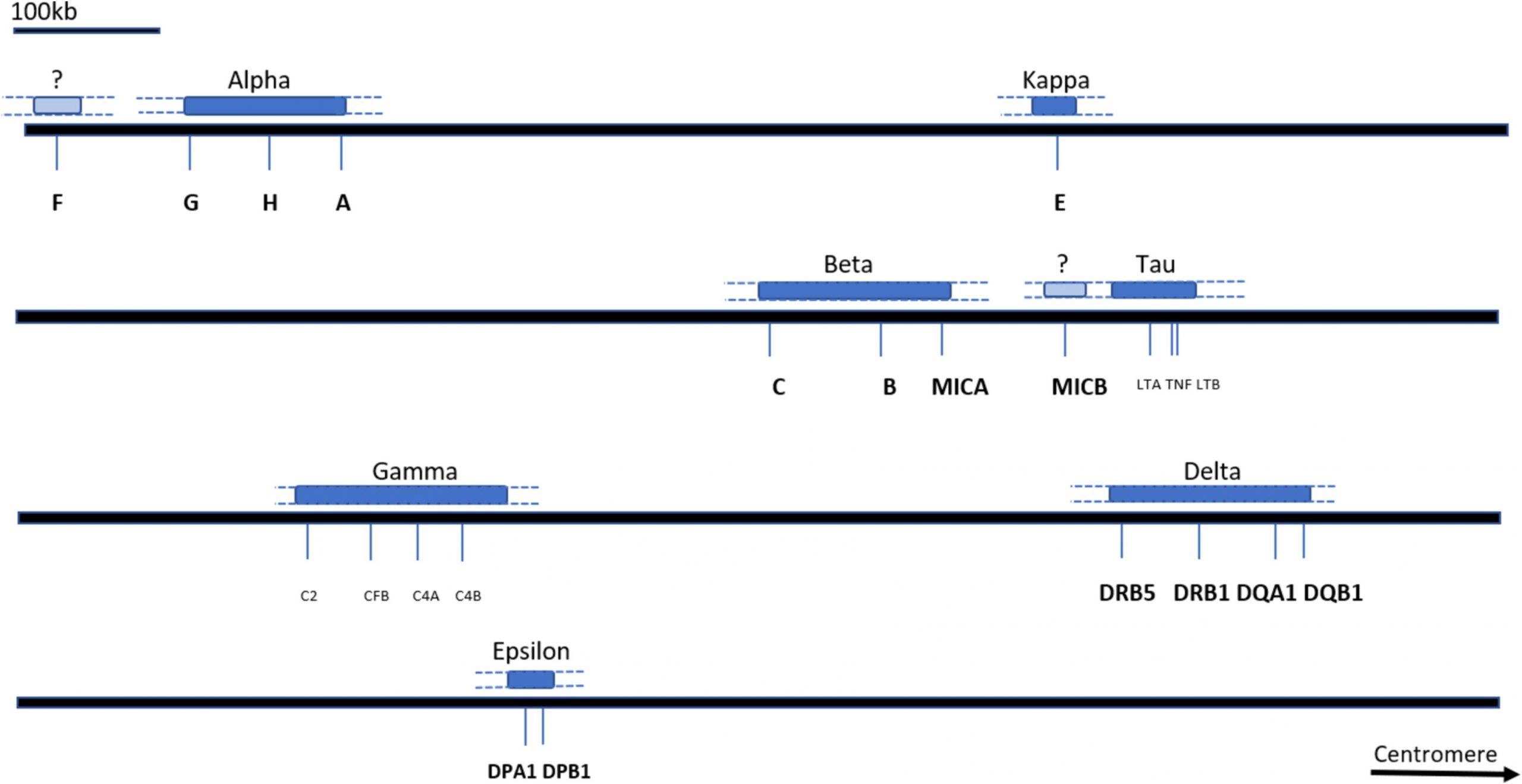
Figure 1: Map of the human MHC from build 38 of the human genome reference [32] showing the PFB structure and location of MHC loci sequenced in this study (in bold). The dark blue horizontal bars indicate the current understanding of PFB structure, and the light blue bars indicate putative PFB suggested by previous studies [7,8,14] and supported by data in this study. The dotted lines indicate the precise block boundaries are not known. MICB may be in a unique block between the Beta and Tau blocks or part of the Tau block. The question mark (?) above HLA-F reflects the unknown block location of HLA-F. The map is shown to approximate scale to highlight the size of the largely uncharacterized regions between the HLA genes. (For interpretation of the references to colour in this figure legend, the reader is referred to the web version of this article.)
The study, which analysed 157 unrelated donor–recipient HCT pairs, focused on non-classical MHC loci (NCML), including HLA-E, HLA-F, HLA-G, HLA-H, MICA and MICB. Surprisingly, genetic mismatches in at least one of these regions were identified in 83% of donor–recipient pairs. Even among pairs that were very closely matched across the major classical HLA loci, almost three-quarters still carried differences in one or more NCML.
These findings suggest that conventional HLA matching may not capture the full extent of genetic compatibility between transplant donors and recipients.
The researchers also explored whether NCML matching was associated with clinical outcomes. Although the differences did not reach statistical significance, patients who were highly matched for both classical HLA genes and NCML appeared to have a higher risk of disease relapse and lower progression-free survival than those who were highly HLA matched but mismatched at NCML.
This unexpected pattern suggests that some non-classical MHC differences could potentially contribute to the graft-versus-leukaemia effect, whereby donor immune cells recognise and eliminate residual cancer cells after transplantation.
The MHC itself is an exceptionally diverse region of the genome and contains large inherited blocks of genetic material that can be passed down together. These conserved regions, known as ancestral or conserved extended haplotypes, can contain multiple genes and genetic variants that are not captured by conventional HLA matching.
By sequencing these additional regions, the researchers are beginning to map the extent of genetic variation that exists between apparently well-matched transplant pairs.
Importantly, the study does not yet establish that NCML mismatching directly causes better or worse transplant outcomes. The cohort was relatively small, and the observed clinical associations were not statistically significant. However, the high frequency of mismatches demonstrates that conventional HLA matching does not necessarily mean that donors and recipients are genetically identical across the broader MHC.
The findings could therefore help explain some of the differences seen between unrelated and sibling donor transplantation and support further investigation into broader MHC matching as a potential factor in donor selection and transplant outcomes.
Donor matching currently focuses heavily on classical HLA genes. This study suggests that looking beyond these regions could reveal additional genetic differences that influence relapse, graft-versus-host disease and long-term transplant success.
Journal article: Sayer, D., et al. 2026. High rates of MHC mismatches in HLA matched unrelated donor/recipient pairs and potential impact on hematopoietic cell transplant outcome. Human Immunology.
Summary by Stefan Botha