


Cancer immunotherapy has transformed modern oncology by harnessing the immune system to recognize and destroy malignant cells. However, despite major advances, many questions remain about why some immune cells successfully eliminate tumours while others fail.
A new technology aims to address this challenge by allowing scientists to observe immune–cancer cell interactions at unprecedented resolution. The platform, called CellTrap, is a miniature lab-on-a-chip system that tracks individual immune cells as they encounter and attack cancer cells (Figure 1).
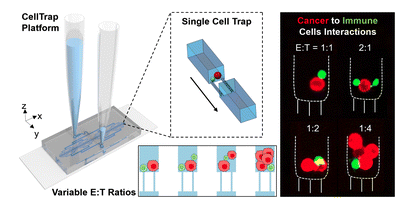
Figure 1: Graphical abstract.
The study provides a new way to investigate the dynamics of cancer immunology by moving beyond population-level measurements and focusing on the behaviour of individual cells.
Traditional laboratory approaches often measure the overall outcome of an immune response, for example, the percentage of cancer cells killed after exposure to immune cells. While useful, these approaches mask the complexity of cellular interactions. They cannot reveal which immune cells are most effective, how long it takes for killing to occur, or what early signals determine whether an immune attack will succeed.
CellTrap was designed to overcome this limitation by capturing and monitoring individual cell interactions over time.
The platform consists of a microfluidic chip containing a central channel that branches into 1,024 microscopic trapping chambers. These chambers allow individual immune cells and cancer cells to be precisely positioned together, while remaining physically separated from neighbouring interactions.
Using time-lapse fluorescence microscopy, researchers can follow these encounters for up to 14 hours, observing how immune cells recognize, activate against, and ultimately destroy tumour cells.
Importantly, the system does not require specialised equipment. The researchers designed CellTrap to operate using standard fluorescence microscopes already available in many laboratories, making it a potentially accessible tool for studying immune responses.
Initial experiments using a glioblastoma model revealed that immune responses are highly dependent on cellular context. When multiple immune cells encountered a single cancer cell, tumour killing occurred more frequently and with greater intensity compared with interactions involving fewer immune cells.
The researchers also observed that early immune activation signals could predict later tumour destruction. This ability to connect the earliest stages of immune recognition with eventual cancer cell death provides a unique opportunity to understand the decision-making process of immune cells during an attack.
Beyond glioblastoma, CellTrap was also tested with additional cancer models, including chronic myeloid leukaemia and adenocarcinoma, demonstrating that the platform can be adapted across different tumour types.
Understanding these individual cellular interactions could be particularly valuable for improving immunotherapies such as immune checkpoint inhibitors, CAR-T cell therapies, and personalised cancer vaccines. Many current treatments rely on activating immune cells, but responses vary significantly between patients and even between individual immune cells within the same tumour environment.
By revealing why some immune cells become effective killers while others remain inactive, technologies such as CellTrap could help identify biomarkers of treatment response and guide the development of more effective therapeutic strategies.
Although the current platform focuses on immune and cancer cells, the researchers emphasise that its applications extend beyond oncology. Because the system can capture and monitor different cell types, it could potentially be used to study a wide range of biological interactions, including infection, inflammation, tissue repair, and regenerative medicine.
Journal article: Khan, M.Z.U, et al. 2026. CellTrap: an instrument-free microfluidic platform for cell–cell interactions at stochastically generated effector-to-target ratios. RSC Advances.
Summary by Stefan Botha