


A new study has provided evidence that replacing the immune system itself may offer a path toward long-term disease control, and potentially remission without ongoing treatment, for patients with severe autoimmune disease (Figure 1).
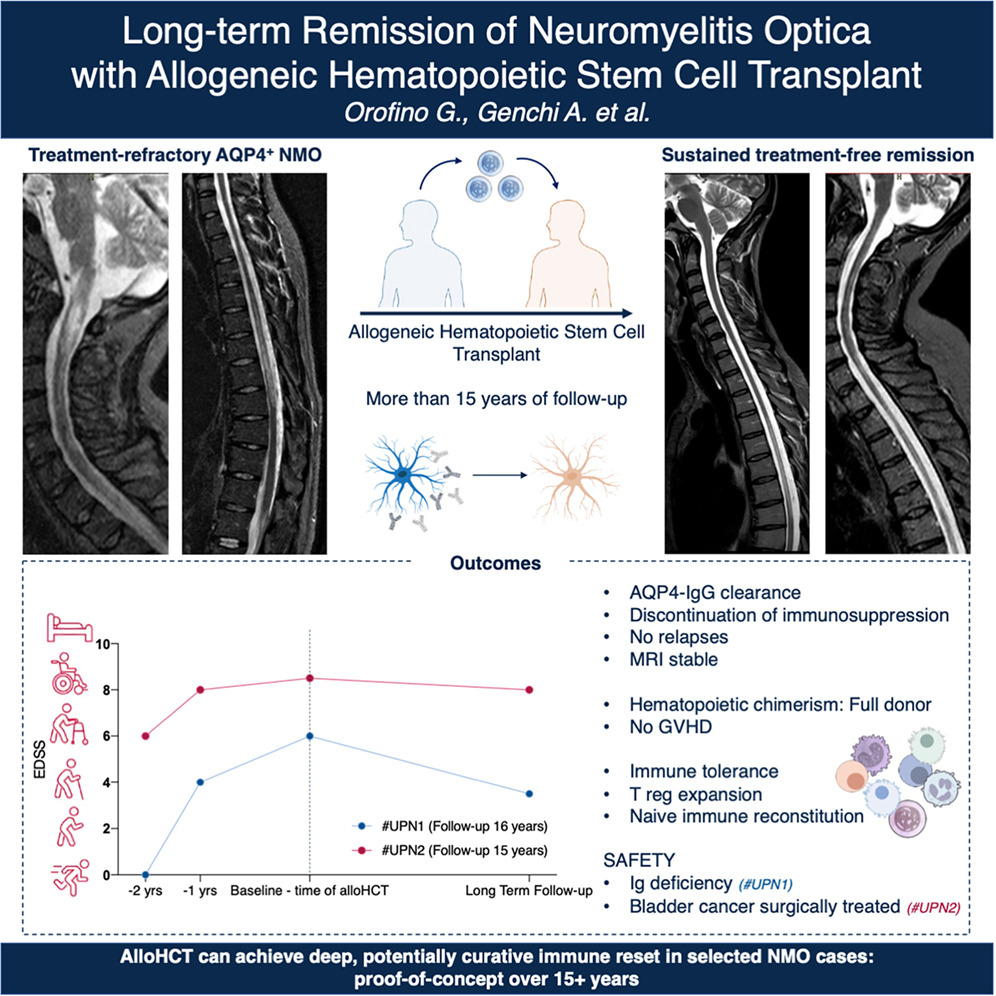
Figure 1: Graphical abstract.
Researchers report the long-term outcomes of two individuals with neuromyelitis optica spectrum disorder (NMOSD), a rare and aggressive autoimmune disease of the central nervous system, who underwent allogeneic hematopoietic cell transplantation (alloHCT) more than 15 years ago. Both patients have remained free from disease relapse, discontinued all immunosuppressive therapies, and showed permanent disappearance of the disease-driving antibodies responsible for their condition.
Neuromyelitis optica is a debilitating autoimmune disorder in which the immune system mistakenly attacks components of the central nervous system, particularly the optic nerves and spinal cord. Many patients develop recurrent episodes of vision loss, paralysis, and neurological disability. Although several targeted immune therapies have transformed disease management, some individuals continue to experience relapses despite treatment, highlighting the need for approaches that provide deeper and more durable immune control.
A major challenge in NMOSD is the persistence of pathogenic aquaporin-4 immunoglobulin G (AQP4-IgG) antibodies, which target water channel proteins on astrocytes in the central nervous system and drive inflammation and tissue damage. Current treatments can suppress antibody production and immune activity, but they do not typically eliminate the underlying autoimmune memory.
In this study, researchers followed two patients with highly treatment-resistant, AQP4-IgG-positive NMOSD who received alloHCT, a procedure that replaces a patient’s immune system with one derived from a healthy donor.
Over 15 years after transplantation, both individuals remained in complete clinical and radiological remission without maintenance immunosuppression. Brain and spinal imaging showed sustained improvement, while AQP4-IgG antibodies became undetectable and remained absent throughout long-term follow-up.
Importantly, the transplanted immune systems remained stable, with full donor-derived immune cell replacement and no evidence of graft-versus-host disease, a major complication associated with donor immune transplantation.
Detailed immune profiling revealed that the new immune systems underwent extensive rebuilding. Both patients developed healthy populations of naïve and memory T and B cells, alongside a more regulated immune environment. One of the most notable findings was the expansion and remodelling of regulatory T cells (Tregs), immune cells responsible for maintaining tolerance and preventing inappropriate immune activation.
This suggests that alloHCT may work not simply by suppressing inflammation, but by fundamentally resetting immune regulation and allowing the development of a more tolerant immune system.
The findings resemble mechanisms observed in other autoimmune conditions where immune system replacement can eliminate autoreactive immune memory. By removing the existing immune repertoire and rebuilding it from donor-derived stem cells, alloHCT may provide an opportunity to break the cycle of chronic autoimmunity.
Beyond disease control, the long-term benefits extended to quality of life. Both patients remained free from immunosuppressive medication, and one individual was able to achieve major personal milestones, including fatherhood, after successful treatment.
However, researchers emphasise that alloHCT is an intensive therapy associated with significant risks, including infection, transplant complications, and treatment-related toxicity. The findings represent a proof-of-concept from only two patients and do not suggest that transplantation should become a standard treatment for all individuals with NMOSD.
Instead, the study provides important evidence that immune replacement strategies may offer a route toward deep, potentially curative disease modification in carefully selected patients with severe autoimmune disease.
Future studies will be needed to determine which patients are most likely to benefit, how risks can be minimised, and whether similar approaches could be applied across other antibody-driven autoimmune disorders.
These findings highlight a broader shift in immunology: rather than permanently suppressing a misdirected immune system, it may be possible in some cases to rebuild immunity from the ground up and restore long-lasting immune tolerance.
Journal article: Orofino, G., et al. 2026. Long-term remission of neuromyelitis optica with allogeneic hematopoietic stem cell transplant. Med.
Summary by Stefan Botha