


For decades, depression has primarily been understood and treated as a disorder of brain chemistry, with most antidepressant medications designed to alter neurotransmitter pathways involving serotonin, dopamine, and norepinephrine. However, growing evidence suggests that depression is not a single biological disease, but rather a collection of different conditions with diverse underlying mechanisms.
Now, a new clinical trial has provided early evidence that targeting the immune system may offer a new treatment approach for a subset of people with depression, particularly those who have not responded to conventional antidepressants (Figure 1).
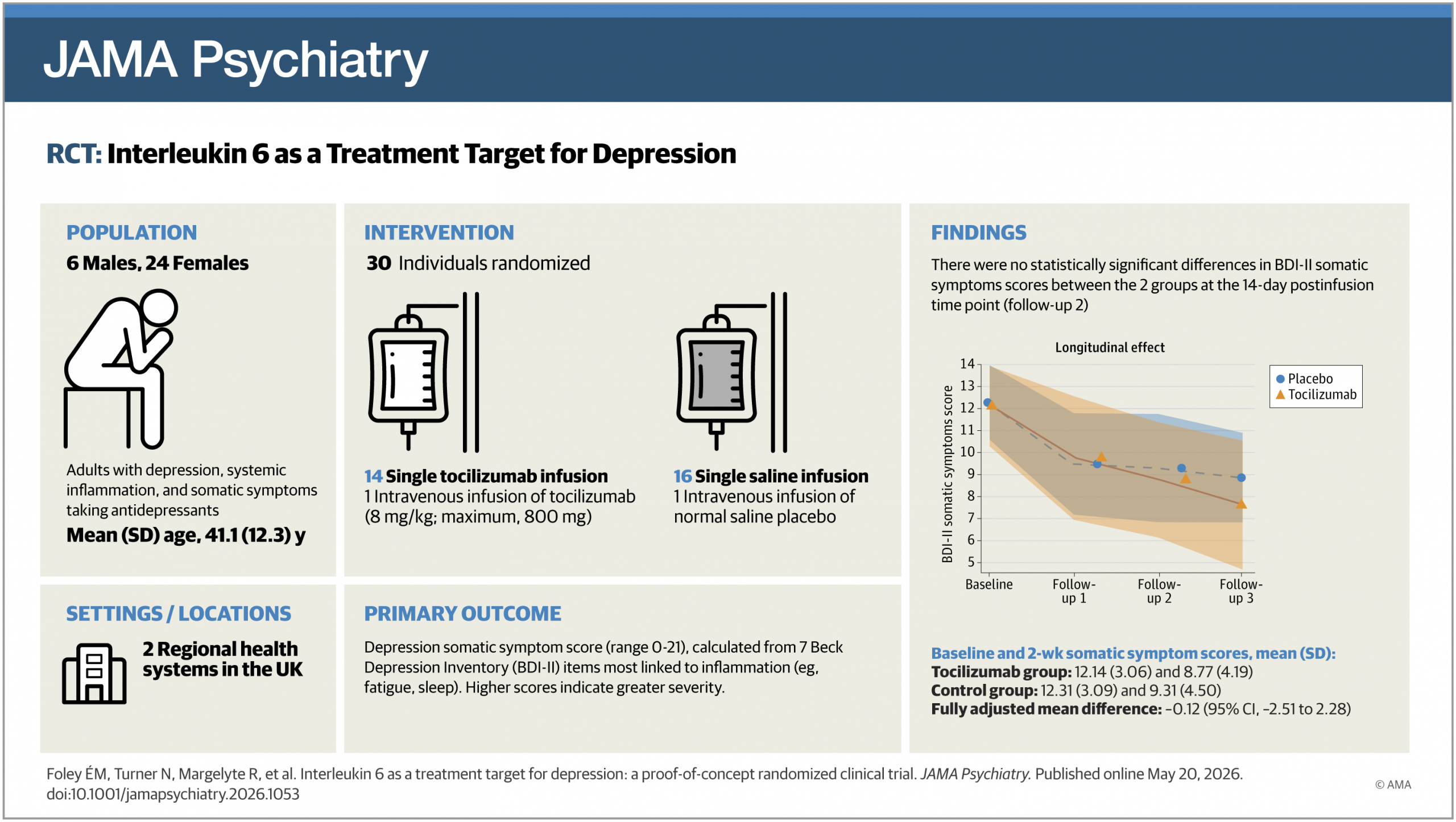
Figure 1: Graphical abstract.
Researchers have shown that blocking the inflammatory cytokine pathway interleukin-6 (IL-6) using the immune-modulating drug tocilizumab may improve symptoms in individuals with treatment-resistant depression and evidence of low-grade inflammation.
The findings represent one of the first randomised controlled trials testing a targeted immunotherapy approach for depression.
Although depression is traditionally classified as a psychiatric disorder, research over the past decade has revealed strong links between immune activation and mental health. Approximately one-third of people with depression show evidence of increased inflammatory activity in their blood, including elevated levels of inflammatory cytokines.
One cytokine that has attracted particular interest is IL-6, a central regulator of immune responses involved in inflammation, acute-phase reactions, and communication between immune cells and tissues.
Elevated IL-6 levels have been associated with:
- increased depressive symptoms,
- fatigue,
- anxiety,
- cognitive difficulties,
- poorer response to standard antidepressant therapies.
Previous genetic studies, including Mendelian randomisation analyses, have suggested that IL-6 signalling may not simply correlate with depression but may contribute causally to disease development.
This has raised an important question:
Could reducing inflammation improve depression symptoms in individuals whose illness is driven, at least partly, by immune dysfunction?
To investigate this possibility, researchers conducted a four-week, double-blind, randomised controlled pilot trial involving 30 adults with moderate-to-severe depression.
Tocilizumab is already approved for inflammatory diseases including rheumatoid arthritis, where it reduces immune activation by interrupting IL-6 signalling. Because this was a small proof-of-concept study, it was not powered to definitively demonstrate statistical differences between groups. However, researchers observed consistent improvements among participants receiving tocilizumab across multiple clinical outcomes.
Compared with placebo, the treatment group showed greater improvements in:
- overall depression severity,
- fatigue,
- anxiety symptoms,
- quality of life.
Notably, remission rates were higher among individuals receiving immune therapy:
- Tocilizumab group: 54% achieved remission
- Placebo group: 31% achieved remission
This corresponds to a number needed to treat (NNT) of approximately 5, meaning that treating five patients with this approach could result in one additional person achieving remission compared with placebo.
For comparison, commonly used selective serotonin reuptake inhibitors (SSRIs) have an estimated NNT of around 7 in moderate-to-severe depression. The importance of this study extends beyond the specific drug tested.
Rather than suggesting that inflammation causes all depression, the findings support a growing concept in psychiatry: immune-mediated depression may represent a distinct biological subtype.
This approach moves toward a model where patients are classified not only by symptoms but also by underlying biological mechanisms. Similar strategies are already transforming fields such as oncology and rheumatology, where molecular biomarkers guide treatment selection.
In depression, inflammatory biomarkers such as IL-6 could eventually help identify individuals most likely to benefit from immune-targeting therapies.
Researchers have proposed several interconnected mechanisms:
- Inflammatory molecules can influence neural circuits involved in mood regulation, motivation, and stress responses.
- Inflammation can affect pathways involved in serotonin, dopamine, and glutamate regulation.
- Persistent immune activation can alter metabolism, contributing to fatigue and reduced motivation.
- Inflammatory signalling interacts with the hypothalamic-pituitary-adrenal (HPA) axis, a major regulator of stress responses.
Together, these pathways may help explain why some individual’s experience depression alongside physical symptoms such as exhaustion and inflammatory changes.
Additionally, tocilizumab is an immune-modulating medication with potential risks, including increased susceptibility to infections, meaning its use in depression would require careful patient selection and monitoring.
As immunology and neuroscience increasingly converge, immune-targeting therapies may open a new chapter in precision psychiatry, bringing the possibility of “the right treatment for the right patient at the right time” closer to reality.
Journal article: Foley, E.M., et al. 2026. Interleukin 6 as a Treatment Target for DepressionA Proof-of-Concept Randomized Clinical Trial. JAMA Psychiatry.
Summary by Stefan Botha