


For decades, scientists have viewed lymph nodes as highly organized immune hubs where T cells, B cells, and antigen-presenting cells coordinate responses against invading pathogens. However, new research published reveals that chronic tuberculosis (TB) infection can fundamentally reshape this architecture, creating an environment that limits effective T cell immunity and allows the pathogen to persist (Figure 1).
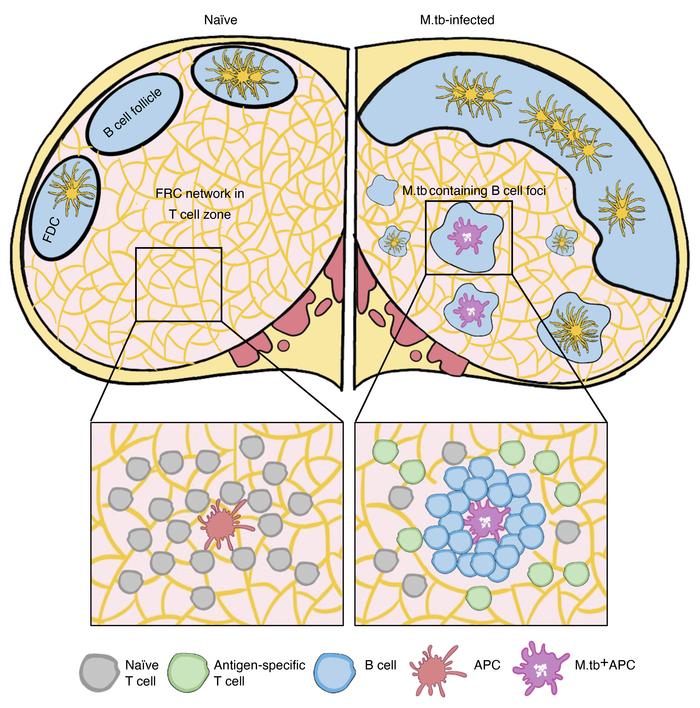
Figure 1: Graphical abstract.
The study demonstrates that Mycobacterium tuberculosis actively remodels draining lymph nodes during chronic infection by altering the positioning of immune cells. These structural changes impair the ability of naïve T cells to encounter antigen-presenting cells and become activated, ultimately weakening host defence.
Secondary lymphoid organs such as lymph nodes are carefully organized to maximize communication between immune cells. Fibroblastic reticular cells (FRCs) produce chemokines such as CCL21 that guide T cells into specific regions where they can interact with dendritic cells and macrophages presenting foreign antigens.
The researchers found that chronic TB infection disrupts this organization. In infected lymph nodes, B cells accumulated in unusually high numbers and migrated into the T cell-rich paracortex, where they are not typically dominant.
These displaced B cells formed clusters together with CD35⁺ follicular dendritic cells, creating structures that physically altered the normal lymph node landscape.
As B cell clusters expanded, they disrupted networks of CCL21-producing fibroblastic reticular cells that normally help coordinate T cell trafficking.
This remodelling had two major consequences:
- Pathogen-containing myeloid cells became spatially separated from antigen-specific CD4⁺ T cells.
- Naïve T cells were less likely to encounter antigen-presenting cells carrying mycobacterial antigens.
In essence, the infection created a form of immune compartmentalization that reduced productive interactions between key immune cell populations.
The result was a significant impairment in the activation of CD4⁺ T cells, the very cells required for controlling intracellular pathogens such as M. tuberculosis. B cells are traditionally viewed as beneficial immune cells that produce antibodies and support adaptive immunity. However, this study highlights a less appreciated role for B cells in shaping lymphoid tissue architecture. When researchers experimentally depleted B cells during chronic TB infection, lymph node organization was restored. CCL21-producing stromal networks re-emerged, immune cell positioning normalized, and bacterial burdens within lymph nodes decreased.
These findings suggest that excessive B cell accumulation contributes directly to immune dysfunction during chronic infection. Importantly, the effects were not limited to responses against tuberculosis. The altered lymph node architecture also impaired activation of naïve CD4⁺ T cells responding to unrelated antigens, indicating a broader suppression of immune responsiveness.
Tuberculosis remains one of the world’s leading infectious killers, partly because M. tuberculosis has evolved sophisticated strategies to evade immune clearance. While much attention has focused on bacterial survival mechanisms within macrophages, this study reveals another layer of immune evasion: manipulation of the host’s lymphoid architecture. Rather than directly suppressing T cells, chronic infection appears to alter the physical organization of the immune system itself, preventing effective communication between antigen-presenting cells and T cells.
This concept aligns with growing evidence that tissue architecture is not merely a passive backdrop for immune responses but an active determinant of immune function. The findings raise therapeutic possibilities. Interventions that preserve or restore lymph node organization could potentially improve immune responses during chronic infections such as tuberculosis. More broadly, the study suggests that immune dysfunction in chronic inflammatory diseases may arise not only from altered cellular activity but also from disruption of the spatial networks that govern immune cell interactions.
As spatial biology technologies continue to advance, understanding how pathogens reshape immune tissues may uncover new approaches for enhancing protective immunity and overcoming chronic infection.
Journal article: Daniel, L., et al. 2026. Stromal structure remodeling by B lymphocytes limits T cell activation in lymph nodes of Mycobacterium tuberculosis–infected mice. JCI.
Summary by Stefan Botha