


A new study reveals that creatine, a supplement best known for its use in sports and bodybuilding, may play an unexpected role in cancer immunity (Figure 1). The research shows that creatine not only enhances the function of cancer-fighting T cells, as previously demonstrated, but also strengthens dendritic cells, the immune system’s key antigen-presenting cells that initiate and coordinate anti-tumour responses.
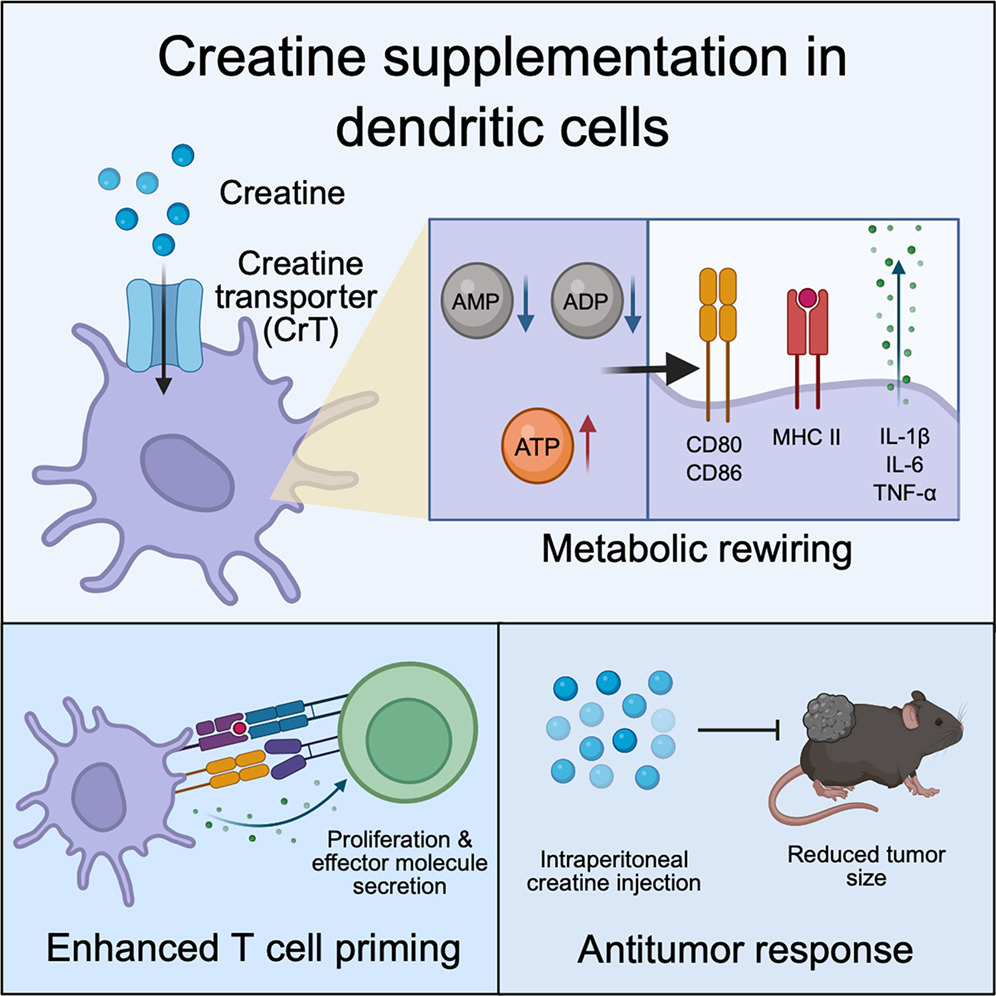
Figure 1: Graphical abstract.
Cancer immunotherapy has revolutionized oncology by harnessing the body’s own immune system to attack tumours. However, despite remarkable successes, only a minority of patients achieve durable responses. Most current immunotherapies focus on reinvigorating cytotoxic CD8⁺ T cells, the immune system’s primary tumour-killing cells. Yet effective T cell responses depend on dendritic cells, which capture tumour antigens, process them, and present them to T cells to initiate immune activation. Understanding how to support dendritic cell function has therefore become an important area of cancer immunology research.
The team discovered that dendritic cells within tumours express unusually high levels of the creatine transporter, suggesting that these cells actively increase creatine uptake in the challenging metabolic environment of the tumour microenvironment. Tumours are highly competitive ecosystems where rapidly dividing cancer cells consume large amounts of nutrients, often leaving immune cells metabolically exhausted and unable to function effectively.
To determine whether creatine was important for dendritic cell biology, researchers generated dendritic cells lacking the creatine transporter. Without the ability to import creatine, these cells exhibited impaired survival, reduced activation, and a diminished capacity to stimulate T cells. When cultured alongside T cells, creatine-deficient dendritic cells were less effective at promoting T cell proliferation and cytokine production, indicating a fundamental defect in their ability to coordinate anti-tumour immunity.
The investigators then asked whether increasing creatine availability could have the opposite effect. In mouse models of melanoma, creatine supplementation significantly slowed tumour growth and increased both the abundance and activation of dendritic cells within tumours. These dendritic cells also produced higher levels of chemokines and inflammatory mediators that recruit additional immune cells to the tumour site, helping to amplify the anti-cancer response.
Mechanistically, metabolomic analyses revealed that creatine supplementation increased intracellular ATP levels within dendritic cells. ATP serves as the primary energy currency of the cell and is required for virtually every aspect of immune activation, including antigen processing, cytokine production, migration, and T cell priming. The findings suggest that creatine acts as an energy buffer, allowing dendritic cells to maintain adequate energy reserves even in nutrient-poor tumour environments.
This metabolic support proved particularly important for sustaining inflammatory signalling pathways that are necessary for dendritic cell activation. By stabilizing cellular energy availability, creatine enabled dendritic cells to remain functional despite the metabolic pressures imposed by growing tumours.
Importantly, the findings extended beyond mouse models. When human monocyte-derived dendritic cells were treated with creatine in vitro, they exhibited enhanced activation and improved ability to stimulate human T cells against cancer-associated antigens. This observation is particularly relevant because monocyte-derived dendritic cells are commonly used in experimental dendritic cell vaccines. Incorporating creatine during vaccine manufacturing could potentially improve the potency of these cellular therapies before administration to patients.
The study builds upon previous work from the same laboratory demonstrating that creatine enhances the metabolic fitness of cytotoxic T cells. Together, the findings suggest that creatine may support multiple levels of the anti-tumour immune response. Rather than acting solely on the immune system’s “soldiers”, the killer T cells, creatine also appears to strengthen the “command centre” responsible for activating and directing those responses.
The work highlights a broader theme emerging in cancer immunology: immune cell metabolism is a critical determinant of therapeutic success. As researchers continue to uncover the metabolic requirements of different immune cell populations, interventions that improve cellular energy utilization may complement existing immunotherapies and enhance their effectiveness.
While the results are promising, the authors emphasise that the research was conducted in laboratory models and human cells, not cancer patients. Clinical studies will be required to determine whether creatine supplementation can safely improve outcomes in individuals receiving immunotherapy. Nevertheless, the findings provide compelling evidence that a simple metabolic molecule may have far-reaching effects on anti-tumour immunity.
Journal article: Kang, E., et al. 2026. Creatine uptake promotes dendritic cell activation and enhances antitumor immunity. iScience.
Summary by Stefan Botha