


New research is shedding light on the complex role of immune cells in colorectal tumours, revealing that certain types of neutrophils may be associated with better patient outcomes (Figure 1).
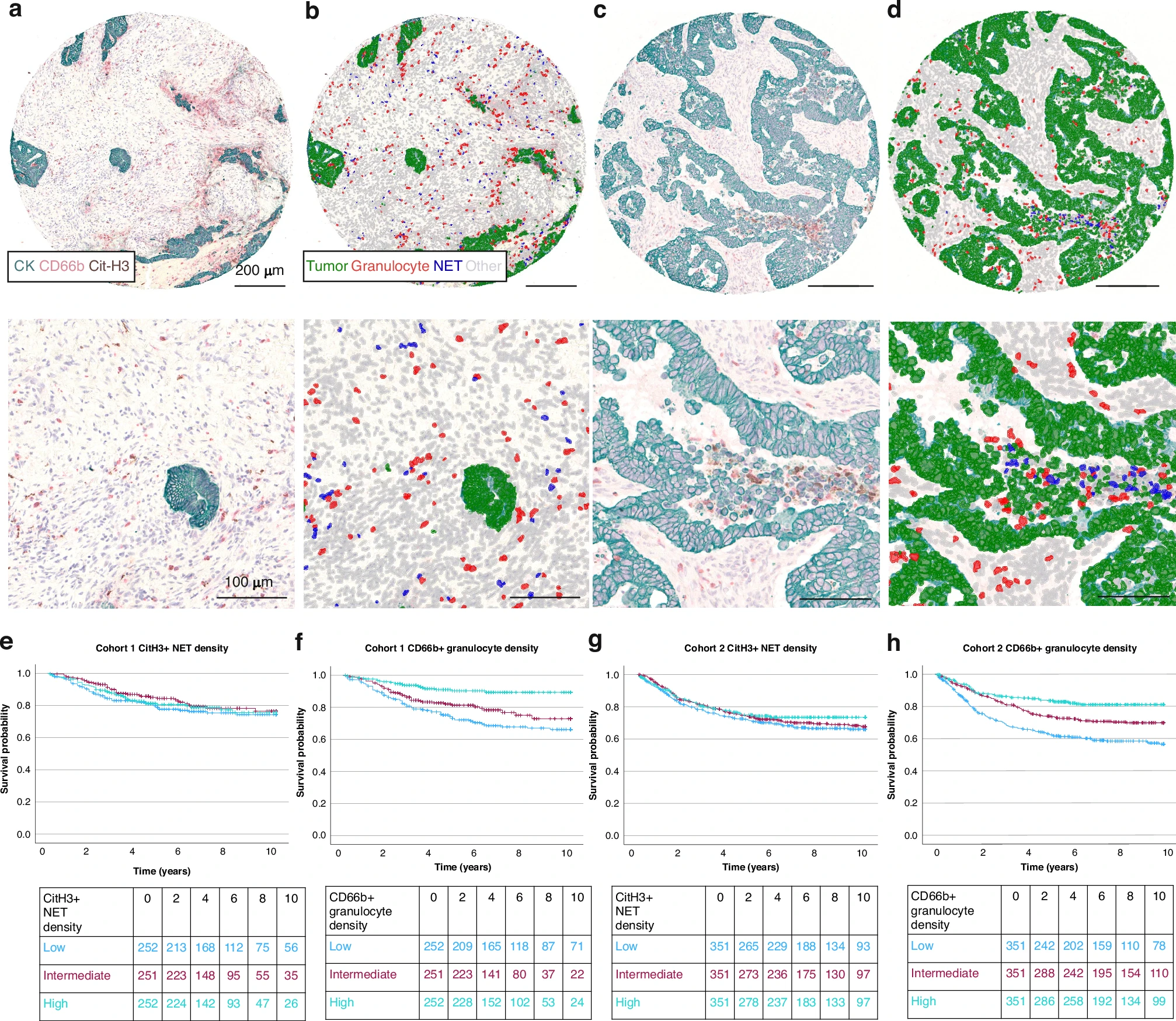
Figure 1: Multiplex immunohistochemistry, image analysis and Kaplan-Meier survival analyses. a, c show representative examples of the three-plex immunohistochemistry assay for the identification of neutrophil extracellular traps (NETs), granulocytes, and tumor cells. b, d show corresponding QuPath object classifier result images for the same regions. Scale bars represent 200 µm in the top row and 100 µm in the bottom row. e–h show relationships of citrullinated histone H3 positive neutrophil extracellular traps (e, g) and CD66b positive granulocytes (f, h) with survival in Cohorts 1 (e, f) and 2 (g, h).
Neutrophils are the most abundant granulocytes found within the tumour microenvironment. These immune cells can have both cancer-promoting and cancer-fighting roles. One mechanism attracting attention is the formation of Neutrophil Extracellular Traps (NETs), web-like structures released by activated neutrophils that can trap pathogens but have also been linked to tumour growth and metastasis.
To better understand their role in cancer, researchers analysed tumour samples from three large cohorts of patients with Colorectal Cancer.
Using multiplex immunohistochemistry and digital image analysis, the team measured:
- NETs marked by Citrullinated Histone H3 (Cit-H3)
- Granulocytes identified by the surface marker CD66b (CEACAM8)
Machine-learning–based image analysis was used to quantify the density of these immune components within tumour tissue.
The study found that tumours with higher levels of Cit-H3–positive NETs tended to also have more macrophages and higher levels of inflammatory signalling molecules such as CX3CL1 and ANGPT2.
However, despite these associations with immune activity, the presence of NETs themselves did not predict patient survival.
In contrast, tumours with higher densities of CD66b-positive granulocytes showed significantly better outcomes.
Across the largest patient cohort in the study, individuals with high granulocyte infiltration had roughly half the risk of colorectal cancer–specific death compared with those with low levels. Importantly, this association remained significant even after adjusting for standard prognostic factors.
These findings highlight the complex role of neutrophils in cancer biology. While NET formation has been proposed as a mechanism that could promote tumour progression, the broader presence of neutrophils within colorectal tumours may signal a stronger anti-tumour
Journal article: Rahkola, O, et al. 2026. Significance of tumor infiltrating granulocytes and neutrophil extracellular traps in colorectal cancer. BJC.
Summary by Stefan Botha